Whether your hair loss is temporary or permanent depends entirely on its cause, and more specifically on whether your follicles are still intact. That is a question a scalp examination can answer. Here is how to start reading the signs. This is usually the question beneath every other question about hair loss. And it is …


Whether your hair loss is temporary or permanent depends entirely on its cause, and more specifically on whether your follicles are still intact. That is a question a scalp examination can answer. Here is how to start reading the signs.
This is usually the question beneath every other question about hair loss. And it is the right question to ask, because the answer changes everything about how you approach it.
The good news is that the majority of hair loss in women is not permanent. The frustrating reality is that without a proper assessment, it is genuinely difficult to know which type you are dealing with. Some conditions that look similar on the surface have very different prognoses.
The Central Question: Are Your Follicles Still There?
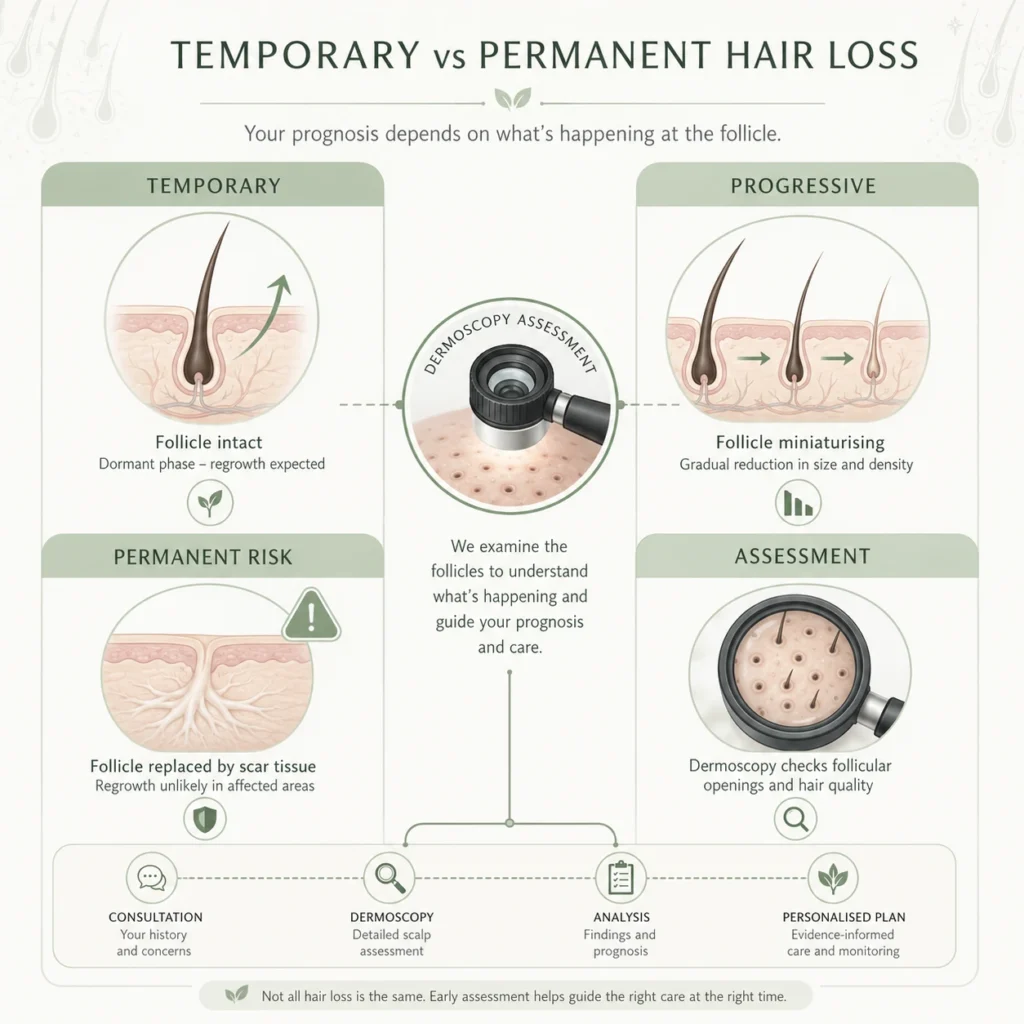
Every strand of hair grows from a follicle beneath the surface of the scalp. As long as that follicle is alive and intact, hair can regrow. The distinction between temporary and permanent hair loss almost always comes down to follicular health.
In reversible hair loss, the follicle is dormant. It has paused activity but has not been destroyed. In permanent hair loss, the follicle has been replaced by scar tissue and can no longer produce hair. Understanding the hair growth cycle helps explain why even dormant follicles can recover, but also why time matters when inflammation is involved.
Types of Hair Loss That Are Almost Always Temporary
Telogen Effluvium
Telogen effluvium is reactive, all-over shedding triggered by stress, illness, nutritional deficiency, or hormonal shift. The follicles are entirely healthy. They have simply been pushed into the resting phase ahead of schedule, usually by a physiological stressor two to three months earlier.
Once the trigger resolves and nutritional foundations are in order, the hair cycle restores and regrowth follows. This is the most common cause of sudden diffuse shedding in women and is almost always temporary.
Alopecia Areata
Despite its alarming appearance, typically smooth well-defined round bald patches, alopecia areata is a non-scarring condition. The immune system attacks the follicles but does not destroy them. Regrowth is possible and in limited presentations often occurs spontaneously. More extensive alopecia areata carries a less certain prognosis, but the follicles remain viable.
Traction Alopecia If Caught Early
Hair loss caused by repeated tension from tight braids, extensions, or high ponytails can be reversed if identified before follicular damage becomes permanent. Early traction alopecia responds well to removing the source of tension. Left long-term, follicular damage becomes irreversible, which is why timing matters.
Types of Hair Loss That May Be Progressive or Permanent
Female Pattern Hair Loss
Female pattern hair loss is a progressive miniaturisation of follicles driven by androgen sensitivity. It does not cause permanent follicular destruction in the way scarring alopecias do, but it is progressive. The follicles gradually reduce in size and productivity over time. The earlier it is identified and managed, the more can be preserved. Left unmanaged, long-standing miniaturisation can reach a point where recovery is limited.
Scarring Alopecias Including Lichen Planopilaris
Scarring alopecias, of which lichen planopilaris is the most common, involve active inflammation that destroys follicles and replaces them with scar tissue. Hair loss in affected areas is permanent. The critical goal is early identification: treatment can halt active inflammation and preserve the remaining follicles, but existing scarring cannot be reversed.
This is the category where urgency matters most. If you have a progressively receding hairline with any burning, itching, or scaling around the follicles, please do not wait to get it assessed.
Signs That Suggest Temporary vs Permanent
These are not definitive, and only a clinical assessment can confirm. But the following patterns are useful starting points:
- All-over diffuse shedding with a clear trigger suggests temporary telogen effluvium
- Smooth bald patches with no broken hairs on an otherwise healthy scalp may be alopecia areata, which is non-scarring and potentially reversible
- Gradual thinning concentrated at the crown and parting, worsening slowly over years, suggests female pattern hair loss which is progressive but manageable
- A receding hairline with redness, scaling, or a burning sensation at the follicles warrants urgent assessment for scarring alopecia
- Hair loss at the temples and hairline in someone who wears tight styles regularly suggests traction, with reversibility depending on how long it has been occurring
Why This Is Hard to Answer Without an Assessment
Some conditions look almost identical at first glance. Alopecia areata and trichotillomania both produce patchy hair loss but have different causes and different trajectories. Telogen effluvium and early female pattern hair loss can coexist. Scarring alopecia in its early stages is subtle and easily missed.
Dermoscopy allows a trichologist to assess follicular health directly: whether follicle openings are present, whether inflammation or scarring is visible, and whether the pattern of loss is consistent with a reversible or progressive condition.
You can browse our full range of hair loss conditions to understand what distinguishes each type. If you are genuinely unsure which you are dealing with, a scalp assessment is the most efficient route to an answer.
The Hair & Scalp Clinic is based in Huntingdon, Cambridgeshire. Patients attend from Cambridge, Peterborough, and across the UK. Telehealth consultations are available.
Book a Consultation — hairscalpclinic.co.uk/consultation