Scalp buildup and product sensitivity are among the most common causes of scalp discomfort, persistent itching, and unexplained shedding. They are also among the most frequently overlooked, because the connection between what goes on the scalp and what comes off it is not always obvious.
Many people who attend a clinic with an itchy, flaky, or tender scalp have already tried switching shampoos, reducing wash frequency, or adding scalp treatments. In some cases, those changes help. In others, the products being used are part of the problem, rather than the solution. Getting a clear picture of what is happening at the scalp and follicular level is the most reliable route to understanding why.
Scalp buildup refers to the accumulation of material on the scalp surface or around the base of hair shafts. It can involve sebum, dead skin cells, product residue, or a combination of all three. When buildup is significant, it can create an environment that favours microbial growth and disrupt the normal shedding and renewal of scalp skin.
Not all buildup looks the same. It may present as white or yellowish flakes that sit on the scalp rather than falling freely, a waxy or greasy film at the roots, visible debris at the follicle openings under magnification, or a scalp that feels clogged or heavy despite regular washing.
Buildup is not the same as dandruff. Dandruff, which is an early form of seborrhoeic dermatitis, involves a specific inflammatory response driven by a yeast called Malassezia. Buildup is a physical accumulation with a different cause and a different management approach.
Product sensitivity or irritant dermatitis occurs when the scalp reacts adversely to an ingredient in a shampoo, conditioner, treatment, oil, dry shampoo, or styling product. It sits on a spectrum from mild irritation to a more significant inflammatory response.
At the milder end, sensitivity may produce a scalp that feels tight, itchy, or mildly tender after product use. At the more significant end, it can cause redness, visible inflammation, scaling, and shedding. In some cases, what appears to be a dandruff flare is actually a sensitivity reaction to a product that has been used long-term without any obvious initial problem.
Sensitivity can develop at any point, even to products that have been used without issue for years. Formulations change, the scalp barrier can weaken over time, and cumulative exposure to certain ingredients can tip the balance.
There is a meaningful clinical difference between irritant sensitivity, which is a direct chemical response, and allergic contact dermatitis, which is an immune-mediated reaction. Both can be triggered by hair and scalp products, but they require different approaches. Our page on contact dermatitis explains this in more detail.
Contact dermatitis of the scalp is most commonly caused by fragrances, preservatives such as methylisothiazolinone (MI/MCI), certain surfactants, and chemical components in hair colour. If symptoms develop or worsen following the introduction of a new product, or after colouring or chemical processing, a sensitivity reaction should be considered.
Several factors can contribute to the buildup accumulating on the scalp:
An inflamed, reactive scalp is not the optimal environment for healthy hair cycling. While scalp buildup and sensitivity alone are rarely the primary cause of significant hair loss, they can compound other conditions and make shedding noticeably worse.
In some cases, what appears to be a scalp condition is actually an early sign of another issue. Scalp psoriasis and folliculitis can both present with symptoms that overlap with buildup and sensitivity. Accurate differentiation is important because each requires a different management approach.
Assessment begins with a detailed discussion of your scalp history, the products you use, the frequency and method of washing, and any changes you have noticed in your scalp condition over time. Information about when symptoms started, what makes them better or worse, and whether any products were introduced or changed around the time symptoms began is all clinically useful.
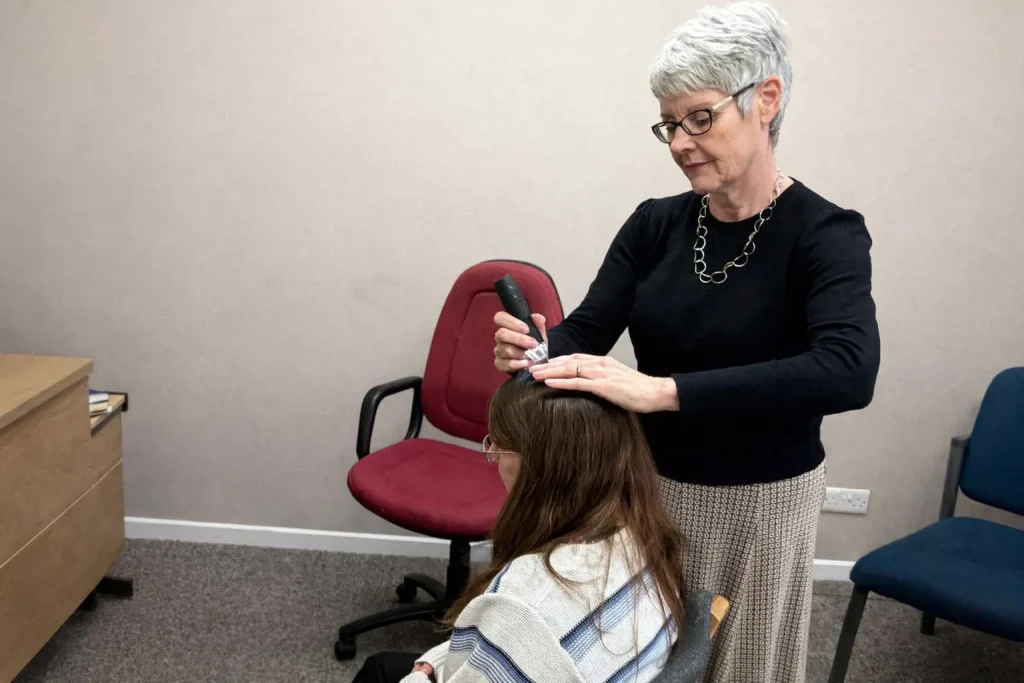
A scalp examination and trichoscopy assessment allow the clinic to look directly at the scalp surface and follicular openings under magnification. Under dermoscopy, buildup appears as irregular adherent material around follicle openings. Inflammation, scaling patterns, and follicular activity can all be assessed at the same time, which helps distinguish buildup from conditions such as seborrhoeic dermatitis or psoriasis.
Where a sensitivity or allergic reaction is suspected, a referral to a dermatologist for possible patch testing may be recommended.
Management depends on the underlying cause identified during assessment. The approach is always targeted rather than generic.
Clarifying the Scalp
Where buildup is significant, a scalp clarification protocol may be recommended to remove accumulated residue without disrupting the scalp’s natural balance. This is different from standard shampoo washing and typically involves specific ingredients suited to the individual’s scalp type.
Product Review
A systematic review of current products can identify likely sensitisers or residue-forming ingredients. In many cases, simplifying the product routine and removing high-risk ingredients produces a significant improvement without any clinical intervention beyond that.
Treating Underlying Scalp Conditions
If buildup has created the conditions for secondary seborrhoeic inflammation, or if a co-existing scalp condition has been identified, management will address that alongside the buildup itself. More detail on the full range of scalp conditions assessed at the clinic is available on the scalp conditions hub page.
Ongoing Scalp Maintenance
Guidance on washing frequency, water temperature, product choice, and scalp massage technique is tailored to each patient. What works for one scalp type can actively worsen another, which is why individualised guidance is more effective than general advice.
For more details on how scalp and hair health are managed at the clinic, visit the treatment and management page.
A trichological assessment is worth booking if you:
The Hair & Scalp Clinic is based in Huntingdon, Cambridgeshire. Patients attend from Cambridge, Peterborough, and across the UK. Telehealth consultations are available for patients unable to attend in person.
Early assessment of scalp buildup and sensitivity can prevent the condition from escalating and identify any co-existing scalp or follicular issues that need attention alongside it.
Scalp buildup is typically caused by a combination of sebum, dead skin cells, and product residue accumulating on the scalp surface or around follicle openings. Contributing factors include infrequent washing, overuse of leave-in products, dry shampoo use, and hard water. In some cases, an underlying scalp condition such as seborrhoeic dermatitis is also present and accelerates the buildup process.
Significant scalp buildup can exacerbate male and female pattern hair loss. While it is rarely the sole cause of meaningful hair loss, it can compound other conditions and worsen shedding. If shedding has increased alongside scalp symptoms, it is worth getting both assessed together.
Common signs of scalp product sensitivity include itching, tightness, or tenderness that appears or worsens after product use; redness or visible inflammation on the scalp; scaling or flaking that is not consistent with dandruff; and symptoms that improve when a product is removed and return when it is reintroduced. A trichological assessment can help confirm whether sensitivity is involved and identify the likely trigger.
No. Dandruff (more precisely described as an early form of seborrhoeic dermatitis) involves a specific inflammatory response driven by yeast activity on the scalp. Scalp buildup is a physical accumulation of sebum, skin cells, and product residue. The two can coexist and are sometimes confused because both produce visible flaking, but they have different causes and require different management approaches.
Mild buildup can often be improved with appropriate clarifying washes and a simplified product routine. However, if symptoms persist or worsen, or if shedding is involved, professional assessment is the most reliable way to understand what is driving the problem and ensure the right approach is used. Some scalp conditions that present like buildup require clinical management rather than a product change.
Common triggers include fragrances and parfum blends, preservatives or surfactants (if you are using the incorrect shampoo for your hair/scalp type), and ingredients found in hair colour and chemical processing products. Sensitivity can develop to almost any ingredient, and it does not always emerge immediately on first use. A systematic product review is the most effective way to identify the likely cause.

Follow Us
Copyright © 2026 The Hair & Scalp Clinic | Developed By