Your GP ran some bloods and everything came back normal. But your hair is still falling out. This is one of the most common frustrations in hair loss — and it almost always comes down to which tests were run and how the results were interpreted. Blood tests are a critical part of understanding hair …

Your GP ran some bloods and everything came back normal. But your hair is still falling out. This is one of the most common frustrations in hair loss — and it almost always comes down to which tests were run and how the results were interpreted.
Blood tests are a critical part of understanding hair loss — but only if you’re testing the right things and reading the results against the right thresholds. Standard GP panels are designed for general health screening. They aren’t designed to assess whether your body has what it needs to sustain healthy hair growth.
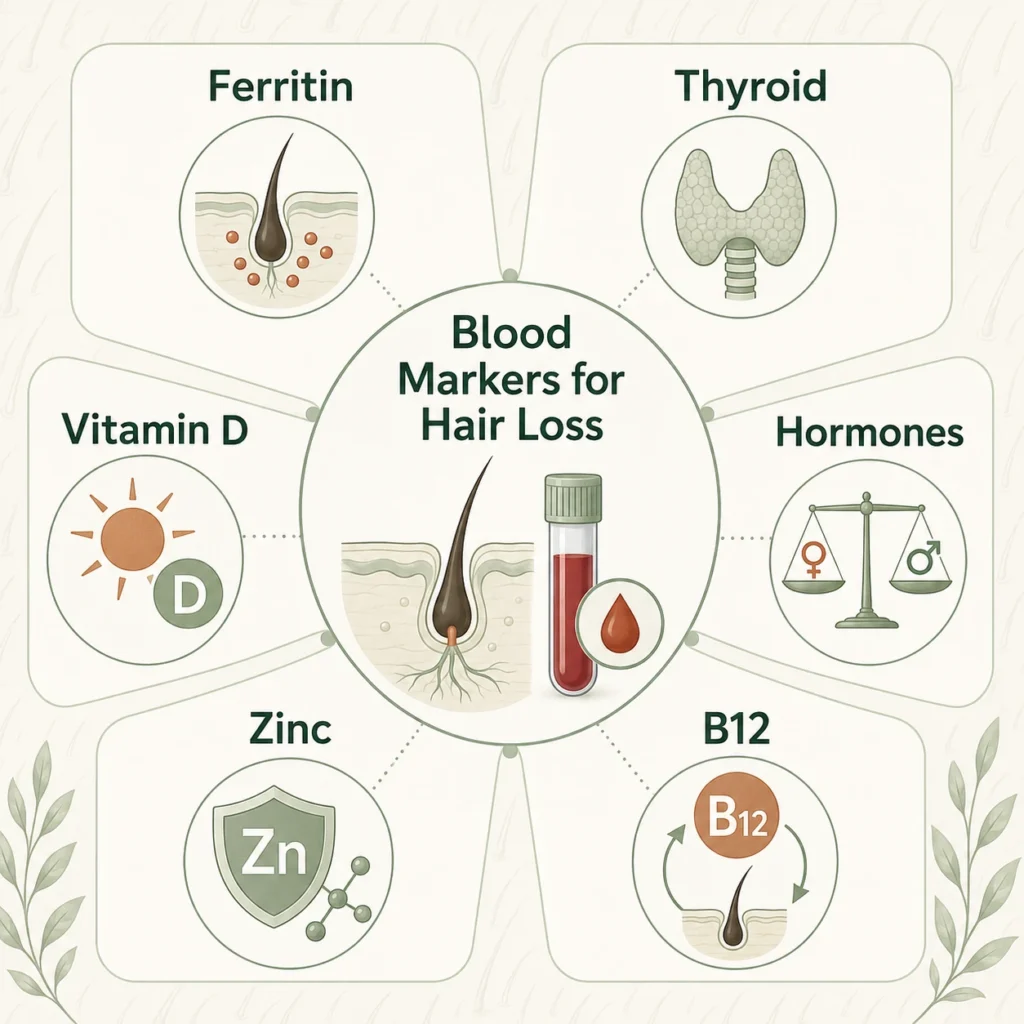
Here is a breakdown of the markers that actually matter, what they reveal, and why some of them are regularly missed.
Ferritin — The Most Commonly Missed Marker
Ferritin is the most important nutritional marker for hair growth — and the one most likely to be overlooked. It measures your stored iron reserves rather than circulating iron, which makes it a far more reliable indicator of whether your body has the iron it needs to sustain the hair cycle.
The standard laboratory reference range for ferritin typically starts at around 12–13 µg/L. A result in that range will come back flagged as normal. But for active hair growth, the relevant threshold is considerably higher — generally above 70 µg/L, with some specialists working to 80–100 µg/L for women experiencing active shedding.
A ferritin of 15 µg/L is not going to cause organ failure. It will, however, significantly impair the hair growth cycle. This gap is the source of enormous frustration for women who’ve been told their results are fine. Our dedicated blog on ferritin and hair loss explains this in more detail.
Ask specifically for ferritin — not just ‘iron’ or a full blood count. These are different tests and don’t give the same information.
Thyroid Function — TSH and Free T4
Both an underactive thyroid (hypothyroidism) and an overactive thyroid (hyperthyroidism) can cause diffuse hair shedding and thinning. Thyroid conditions are significantly more common in women and can develop gradually, with hair loss sometimes being the first noticeable symptom.
TSH (thyroid-stimulating hormone) is usually included in a standard panel. Free T4 is worth requesting alongside it, as TSH alone doesn’t always give a complete picture — particularly in subclinical cases where TSH is borderline but free T4 is already low.
Thyroid dysfunction can mimic or compound telogen effluvium and hormonal hair loss, which is why it should always be ruled out early in any hair loss assessment.
Vitamin D
Vitamin D deficiency is widespread in the UK — estimated to affect around 1 in 5 adults — and is consistently associated with impaired hair cycling. The mechanism isn’t fully understood, but vitamin D receptors are present in hair follicles, and deficiency is a recognised factor in diffuse shedding.
It’s worth knowing that the NHS sufficiency threshold (50 nmol/L) and the level considered optimal for hair health are not the same. Many practitioners working in hair loss aim for levels of 80–100 nmol/L or above.
Sex Hormones — Testosterone, Free Testosterone, and SHBG
For women experiencing androgenetic-pattern thinning — particularly those with PMOS or suspected hormonal hair loss — free testosterone and SHBG (sex hormone-binding globulin) are more clinically informative than total testosterone alone.
SHBG is a protein that binds testosterone in the bloodstream, rendering it inactive. When SHBG is low, a higher proportion of testosterone is biologically active and available to affect follicles. Standard GP panels often measure total testosterone only — requesting free testosterone and SHBG specifically gives a far clearer picture of androgen activity.
LH and FSH
Luteinising hormone (LH) and follicle-stimulating hormone (FSH) provide useful context in cases where PMOS or perimenopausal changes are suspected. An elevated LH:FSH ratio is a common finding in PMOS. In women approaching menopause, rising FSH alongside falling oestrogen explains hormonal hair changes that may present as female pattern hair loss or diffuse thinning.
Fasting Insulin and Glucose
Where insulin resistance is suspected — particularly alongside PMOS symptoms — fasting insulin and fasting glucose help assess how the body is managing blood sugar. Elevated insulin drives increased androgen production from the ovaries and reduces SHBG, compounding the follicular impact of androgens. These markers are not included in standard panels and need to be requested specifically.
Zinc
Zinc deficiency is less common than low ferritin or vitamin D, but it’s worth checking in women with restrictive diets, gastrointestinal conditions, or persistent shedding that hasn’t responded to other interventions. Zinc plays a role in the enzyme activity within the hair follicle and in regulating the hair growth cycle.
Vitamin B12
B12 deficiency causes diffuse shedding and is more common in women following plant-based diets, those with digestive conditions affecting absorption, or those on long-term metformin. It’s usually included in a standard full blood count but worth checking explicitly if dietary restriction is a factor.
How to Use This List
Not every marker on this list is relevant for every person. The tests worth prioritising depend on your pattern of hair loss, your symptoms, your medical history, and your diet. A trichological assessment will look at the clinical picture first — and advise on which specific markers are most useful to investigate in your case.
It’s also worth knowing that results should be interpreted in context, not just against laboratory reference ranges. A result that is technically ‘normal’ can still be suboptimal for hair growth — and understanding that distinction is often the difference between finding a cause and being told nothing is wrong.
For a comprehensive overview of how nutritional factors affect hair, see our guide to nutrition and blood tests in hair loss.
The Hair & Scalp Clinic is based in Huntingdon, Cambridgeshire. Patients attend from Cambridge, Peterborough, and across the UK. Telehealth consultations are available.
Book a Consultation — hairscalpclinic.co.uk/consultation