Minoxidil is one of the most widely discussed options for hair loss in women — and also one of the most misunderstood. It works well for some, does little for others, and in some situations it's the wrong choice entirely. Here's an honest account of what it actually does. If you've been researching hair loss, …


Minoxidil is one of the most widely discussed options for hair loss in women — and also one of the most misunderstood. It works well for some, does little for others, and in some situations it’s the wrong choice entirely. Here’s an honest account of what it actually does.
If you’ve been researching hair loss, you’ve almost certainly come across minoxidil. It’s available over the counter, it’s been used for decades, and for the right type of hair loss it can make a genuine difference. But it’s often presented as a universal solution — which it isn’t.
What Is Minoxidil and How Does It Work?
Minoxidil is a topical preparation — typically a liquid or foam applied directly to the scalp — that works by extending the active growth phase of the hair growth cycle. It was originally developed as a blood pressure medication; hair growth was an observed side effect that led to its development as a hair loss treatment.
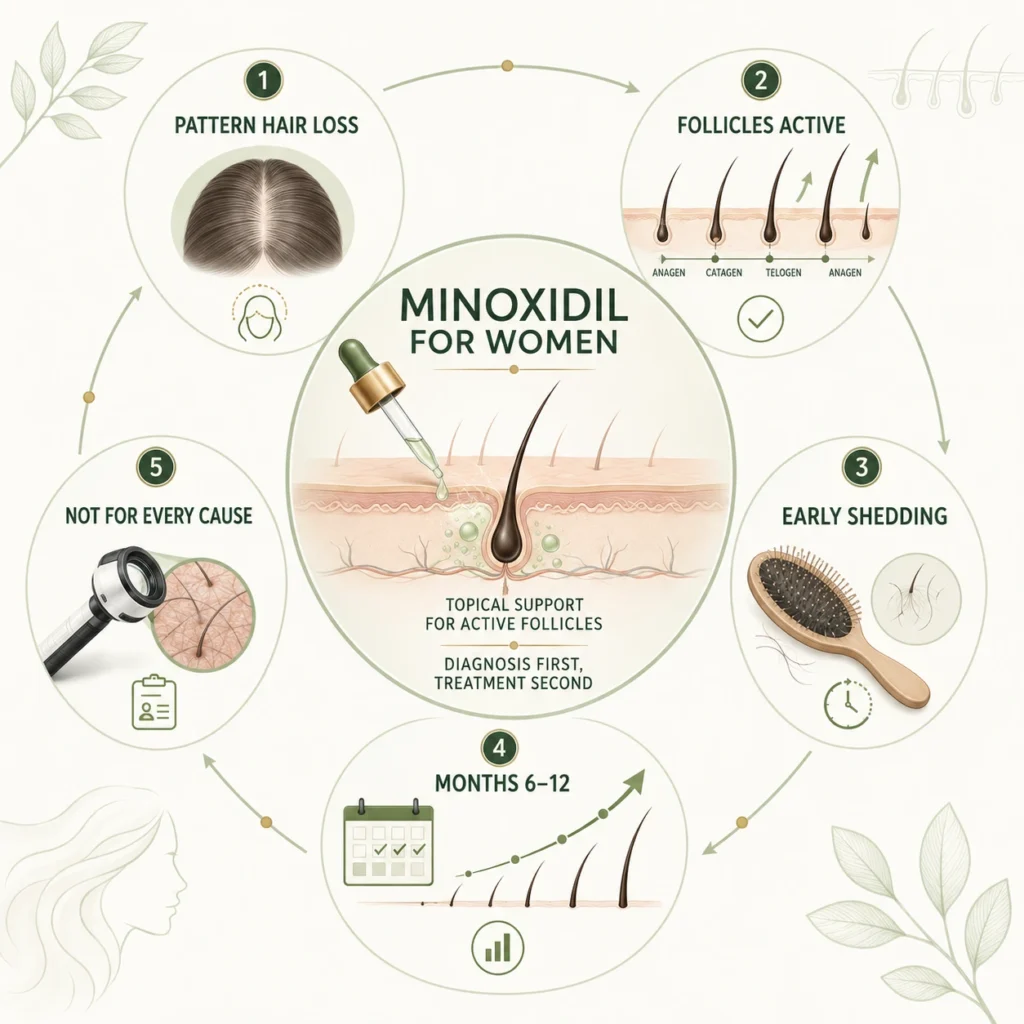
It doesn’t address the underlying cause of hair loss. What it does is encourage follicles that are still viable to remain in, or re-enter, the growth phase for longer. For follicles that have been miniaturising, this can help stabilise hair density and, in some cases, produce visible regrowth.
Who Does It Actually Help?
Minoxidil works best for androgenetic hair loss — what’s known as female pattern hair loss. This is the type of gradual, diffuse thinning across the crown and top of the scalp driven by androgen sensitivity. For women with this pattern of loss, topical minoxidil is a well-established first-line option.
It can also be useful as a supportive measure while the underlying cause of hair loss is being addressed — for example, if hormonal imbalances or nutritional deficiencies are being corrected at the same time.
When It Is Not the Answer
This is the part that often gets left out of the conversation.
Minoxidil does not work for telogen effluvium — the diffuse, all-over shedding triggered by stress, illness, nutritional deficiency, or hormonal change. Telogen effluvium resolves when the underlying trigger is addressed; adding minoxidil to that process is unlikely to speed things up and may add unnecessary complexity.
It is not suitable for alopecia areata — an autoimmune condition requiring a different management approach entirely.
It is not recommended during pregnancy or for women planning to conceive in the near term.
And it won’t be effective if the follicles have been permanently destroyed — for example, in scarring alopecias. Applying minoxidil to areas where follicles are no longer viable will produce no result.
Using minoxidil without knowing the cause of your hair loss is a bit like taking a painkiller without finding out what’s causing the pain. It may mask the problem while the underlying issue continues unchecked.
What to Realistically Expect
If minoxidil is appropriate for your type of hair loss, the timeline looks something like this:
- Weeks 2–8: some women notice an increase in shedding. This is known as the minoxidil shed — follicles are pushed into a new growth cycle, and resting hairs shed to make way for new ones. It is temporary, but it can be alarming if you’re not expecting it.
- Months 3–4: shedding typically reduces. Some stabilisation of hair density may become noticeable.
- Months 6–12: visible improvements in density, where they occur, usually become apparent in this window. Regrowth tends to be fine at first before thickening over time.
Minoxidil requires consistent, ongoing use. If you stop, the benefits are gradually lost — the hair that responded to it will return to its previous state over several months. This is an important thing to factor into the decision.
Getting the Diagnosis Right First
The most important step before starting minoxidil is understanding what type of hair loss you’re dealing with. A trichological assessment will examine the scalp directly, identify the pattern and degree of follicular involvement, and advise whether minoxidil is appropriate — and whether anything else should be addressed alongside it.
If nutritional deficiencies are contributing, addressing those alongside any topical approach tends to produce better outcomes than either in isolation. See our guide to nutrition and blood tests in hair loss for more on this.
The Hair & Scalp Clinic is based in Huntingdon, Cambridgeshire. Patients attend from Cambridge, Peterborough, and across the UK. Telehealth consultations are available.
Book a Consultation — hairscalpclinic.co.uk/consultation