Discovering a bald patch — especially one that wasn't there yesterday — is frightening. Your mind goes straight to worst-case scenarios. The good news is that sudden, patchy hair loss has several possible causes, many of which respond well to early assessment and management. The most important thing you can do right now is not …


Discovering a bald patch — especially one that wasn’t there yesterday — is frightening. Your mind goes straight to worst-case scenarios. The good news is that sudden, patchy hair loss has several possible causes, many of which respond well to early assessment and management.
The most important thing you can do right now is not panic and not wait too long. Here’s what to look for, what the most likely causes are, and what the right next steps look like.
Take a Good Look First
Before anything else, have a proper look at the patch. A few things are useful to note:
- Is the skin smooth and bare, or is there stubble or broken hair?
- Is the edge of the patch well-defined and circular, or is it irregular?
- Is the skin in the patch normal-coloured, or is it red, scaly, or shiny?
- Is there one patch or more than one?
- Is it on the scalp only, or have you also noticed changes to your eyebrows or eyelashes?
These details matter because different causes produce different patterns — and being able to describe what you’re seeing accurately will help a trichologist assess it more efficiently.
What Commonly Causes a Sudden Bald Patch?
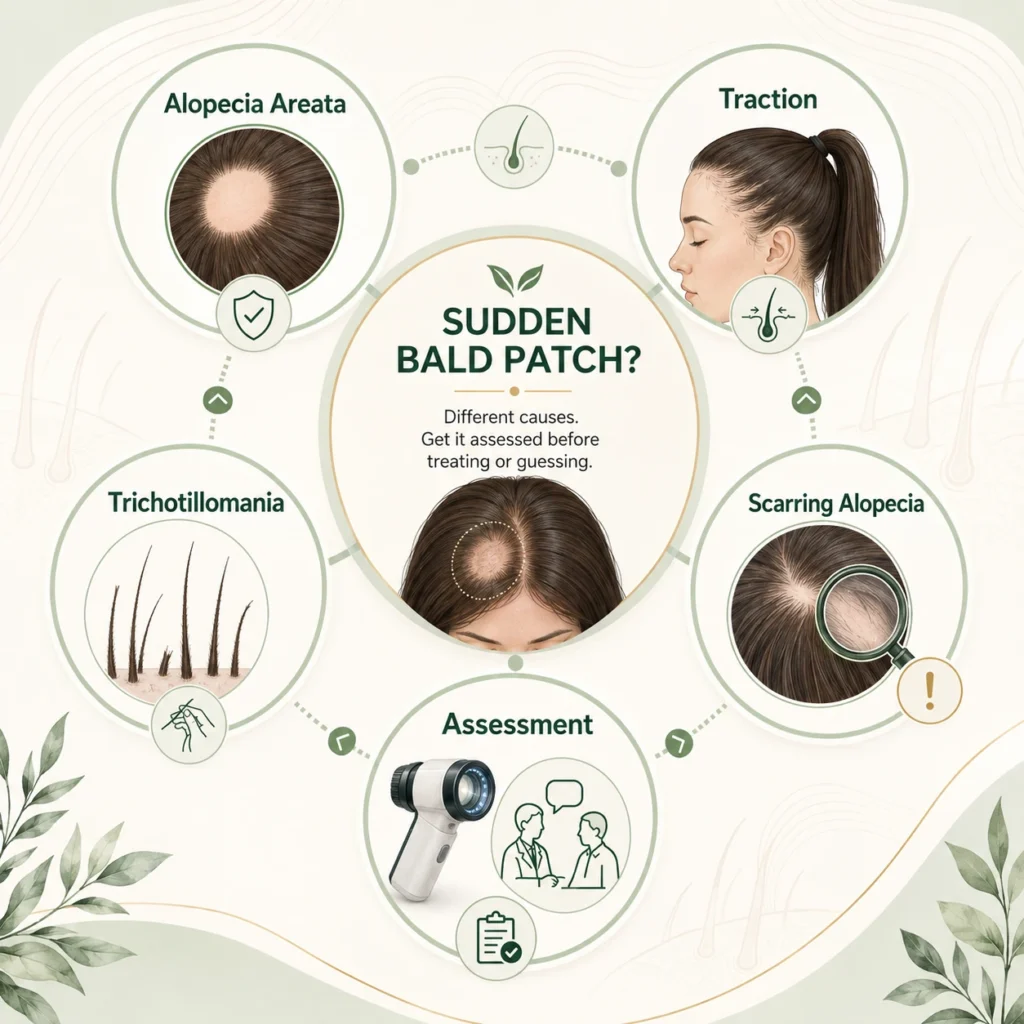
Alopecia Areata
The most common cause of sudden, patchy hair loss. Alopecia areata is an autoimmune condition in which the immune system targets hair follicles, causing smooth, well-defined round or oval patches of hair loss on the scalp. The skin within the patch looks entirely normal — no scaling, no redness, no broken hairs.
The follicles are not destroyed in alopecia areata — they’re dormant. This means regrowth is possible, and in many cases hair does return, particularly when the affected area is limited. Early assessment matters because treatment options in active disease can help, and the pattern of loss needs to be properly identified.
Traction Alopecia
If the patch is at the hairline, temples, or above the ears, and you regularly wear tight hairstyles — braids, buns, ponytails, extensions — traction alopecia is a strong possibility. This is hair loss caused by sustained tension on the follicle. In early stages it is reversible; if tension continues over a long period, follicular damage can become permanent.
Scarring Alopecia
If the patch has a smooth, slightly shiny or pale surface with no follicle openings visible, this warrants urgent assessment. Scarring alopecias — such as lichen planopilaris — involve inflammation that destroys follicles permanently. Early identification and management is essential to preserve surrounding hair.
Trichotillomania
If the patch has broken hairs of irregular lengths, or you are aware of pulling your hair — even automatically or unconsciously — trichotillomania should be considered. A trichologist can distinguish this from alopecia areata clinically, and the assessment is entirely confidential and non-judgemental.
Tinea Capitis
A fungal infection of the scalp that can cause patchy hair loss, often with broken hairs and some scaling or crusting. More common in children but can affect adults. Requires antifungal treatment and diagnosis — do not treat this at home before it’s been confirmed.
What Should You Do Right Now?
- Don’t try to self-diagnose from photos online — the causes of patchy hair loss look similar but require different approaches
- Don’t start applying products to the patch without knowing what’s causing it
- Do book an assessment — sooner rather than later, particularly if the patch has appeared very suddenly or is growing
- Do note any other symptoms — scalp itching, tenderness, burning, or changes to eyebrows and lashes are all useful clinical information
Can a Bald Patch Grow Back?
In many cases, yes — but it depends entirely on the cause and how long it has been present. Understanding the hair growth cycle helps explain why regrowth, when it happens, can take several months to become visible even after the underlying issue is managed.
For alopecia areata specifically, regrowth is common — particularly in limited, early-onset cases. For scarring conditions, the follicles in the affected area cannot regenerate, making early assessment and management critical to preserving the hair around the patch.
When to Book an Appointment
A trichological assessment is the right next step for any sudden, unexplained bald patch — but particularly if the patch is growing, if there are multiple patches, if the skin looks abnormal in any way, or if you have any other scalp symptoms alongside it.
A scalp examination and dermoscopy can identify the cause accurately, distinguish between conditions that can look similar, and give you a clear picture of your options. You can also browse our full range of scalp conditions if you think a scalp issue may be contributing.
The Hair & Scalp Clinic is based in Huntingdon, Cambridgeshire. Patients attend from Cambridge, Peterborough, and across the UK. Telehealth consultations are available.
Book a Consultation — hairscalpclinic.co.uk/consultation