A bit of scalp sensitivity after colouring is very common — but that doesn't mean it should be ignored. There's a significant difference between mild irritation that settles quickly and a reaction that needs proper attention. Here's how to tell which one you're dealing with. If your scalp feels itchy, tight, or uncomfortable after a …

A bit of scalp sensitivity after colouring is very common — but that doesn’t mean it should be ignored. There’s a significant difference between mild irritation that settles quickly and a reaction that needs proper attention. Here’s how to tell which one you’re dealing with.
If your scalp feels itchy, tight, or uncomfortable after a colour treatment, you’re not alone. Many people experience some degree of sensitivity — and there are several different reasons why it can happen, ranging from straightforward irritation to an allergic reaction that warrants prompt action.
Irritation vs. Allergy: Why the Distinction Matters
The two most common causes of post-colour scalp itching look similar on the surface but are very different things.
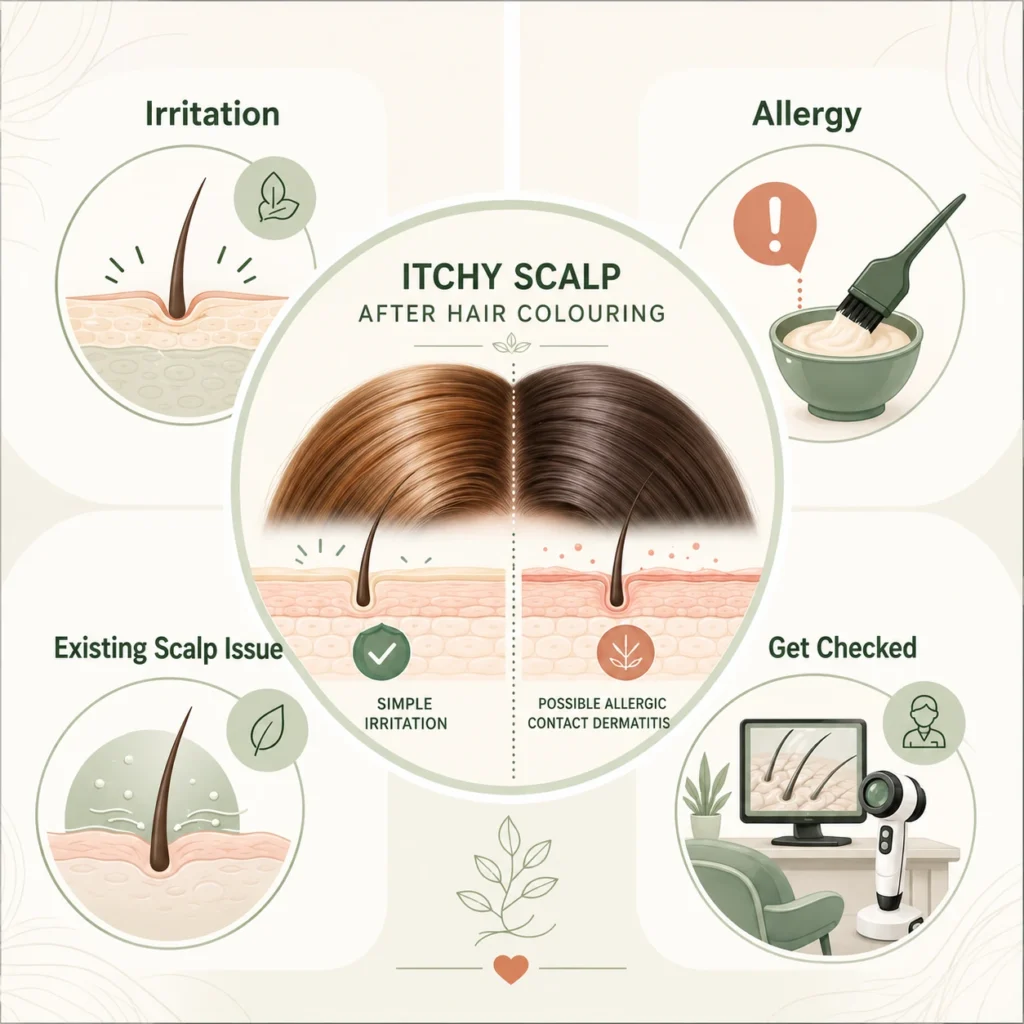
Irritant contact dermatitis is a direct response to the chemicals in hair dye — particularly ammonia, hydrogen peroxide, and other alkaline ingredients. The scalp’s surface is disrupted, and the result is redness, itching, and sometimes a burning sensation during or immediately after the treatment. It settles relatively quickly once the product is rinsed off.
Allergic contact dermatitis is a different process entirely. This is an immune response — the body has been sensitised to a chemical in the dye (most commonly PPD, or para-phenylenediamine) and reacts on re-exposure. Crucially, the reaction is often delayed — it can develop 24 to 72 hours after the colour was applied, which is why people sometimes don’t connect the two. Symptoms can include intense itching, swelling, weeping, or blistering of the scalp and surrounding skin.
If you’ve ever coloured your hair without any problem and then suddenly developed a reaction, this is likely why — sensitisation can develop at any point, even after years of using the same product. See our page on contact dermatitis for a fuller explanation of how this process works.
An allergic reaction to hair dye can escalate quickly in some cases. Swelling around the face, neck, or eyes alongside scalp symptoms requires urgent medical attention — call 111 or go to A&E.
Other Reasons Your Scalp Might React
Not every case of post-colour itching is a contact reaction. Other possibilities include:
- Scalp already compromised — if you colour frequently, use bleach, or have a pre-existing scalp condition, the scalp barrier may be in a weakened state that makes it more reactive to products generally
- Seborrhoeic dermatitis — a common scalp condition that can flare after chemical exposure; see our page on seborrhoeic dermatitis for more detail
- Scalp psoriasis — colouring can aggravate an underlying scalp psoriasis condition, causing a flare in the days that follow
- Product build-up or residue — incomplete rinsing or sensitivity to conditioners and post-colour treatments applied afterwards
What Should You Do After a Reaction?
If the itching is mild and settles within a day or two, focus on keeping the scalp calm — cool water rinses, fragrance-free products, and avoiding heat styling until things settle.
If symptoms are more significant — persistent itching, a rash, visible inflammation, or any swelling — don’t colour your hair again until you’ve had the scalp properly assessed. Repeating a colour treatment on a sensitised scalp can make a reaction substantially worse.
A patch test before every colour is the standard recommendation — and not just the first time you use a product. Formulations change, and sensitisation can develop at any point.
When Is It Worth Seeing a Trichologist?
A trichological assessment is worth booking if:
- You’ve had more than one episode of scalp itching or irritation after colouring
- The itching persists beyond a few days after rinsing
- You have a visible rash, flaking, or inflammation that isn’t settling
- You have an existing scalp condition that seems to be getting worse
- You want to understand whether you can continue colouring safely
A scalp examination can identify whether there’s an underlying condition being aggravated by colour, assess the state of the scalp barrier, and advise on the safest approach going forward. You can read more about our range of scalp conditions on the conditions hub.
The Hair & Scalp Clinic is based in Huntingdon, Cambridgeshire. Patients attend from Cambridge, Peterborough, and across the UK. Telehealth consultations are available.
Book a Consultation — hairscalpclinic.co.uk/consultation