Hair porosity is one of those hair-care terms that sounds more complicated than it needs to be. You may have heard people describe their hair as “low porosity” or “high porosity” when discussing products, frizz, dryness, curls, or wash routines. In simple terms, hair porosity describes how easily your hair absorbs and retains water, oils, …

Hair porosity is one of those hair-care terms that sounds more complicated than it needs to be.
You may have heard people describe their hair as “low porosity” or “high porosity” when discussing products, frizz, dryness, curls, or wash routines. In simple terms, hair porosity describes how easily your hair absorbs and retains water, oils, and hair-care products.
Understanding your porosity can help you choose more suitable products, avoid unnecessary treatments, and build a routine that works with your hair rather than against it.
This guide explains what hair porosity means, how to estimate yours at home, and how to care for low, medium, and high porosity hair.
Quick answer: What is hair porosity?
Hair porosity refers to your hair’s ability to absorb and hold moisture. It is mainly influenced by the condition of the hair cuticle, which is the outer layer of the hair shaft.
- Low porosity hair tends to resist moisture and product absorption.
- Medium porosity hair usually absorbs and retains moisture in a balanced way.
- High porosity hair absorbs moisture quickly but may lose it just as quickly.
Why hair porosity matters
Hair porosity matters because it affects how your hair responds to your daily routine.
It can influence:
- How quickly does your hair get wet
- How long does your hair take to dry
- Whether products absorb or sit on the surface
- How easily your hair becomes frizzy
- How well conditioners and masks work
- How your hair responds to colouring or heat styling
- Whether your hair still feels dry after using products
This is why two people can use the same shampoo, conditioner, or mask and get completely different results. One person’s hair may feel soft and manageable, while another person’s hair may feel heavy, greasy, or still dry. Porosity is one reason this happens.
The hair structure behind porosity
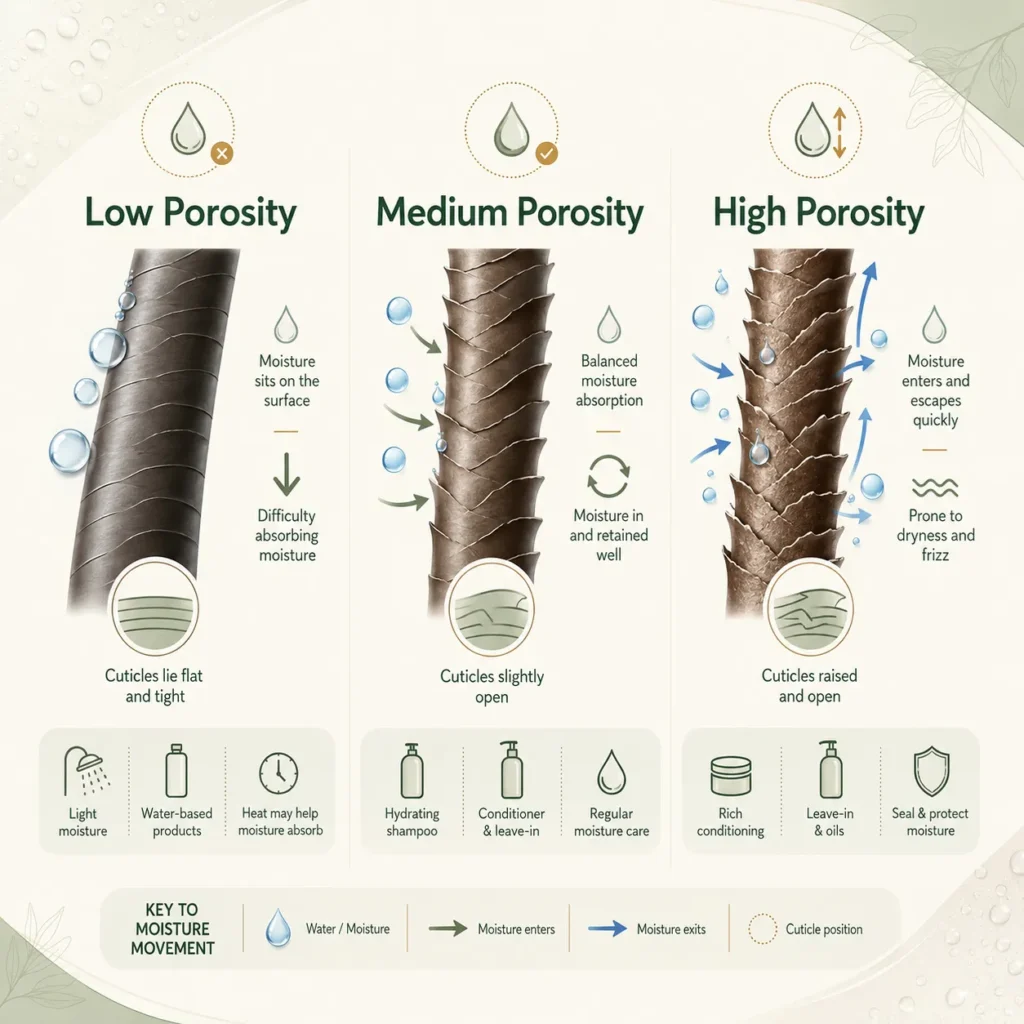
To understand porosity, it helps to understand the hair shaft. The hair shaft is usually described in three main parts: the cuticle, cortex, and medulla. The cuticle is the outer protective layer, made from overlapping scale-like cells.
Think of the cuticle a little like roof tiles. When the cuticle sits flatter and tighter, it can be harder for water and products to enter the hair. This is usually described as low porosity. When the cuticle is more raised, open, or damaged, water can enter more easily, but it may also leave more quickly. This is usually described as high porosity.
The three main types of hair porosity
Low porosity hair
Low porosity hair has a tighter cuticle structure. This means water and products may not absorb quickly. You may have low porosity hair if your hair takes a long time to get fully wet, water appears to sit on the surface at first, or products feel as though they are coating the hair.
Medium porosity hair
Medium porosity hair is often the easiest to manage. It tends to absorb and retain moisture in a balanced way. You may have medium porosity hair if your hair gets wet fairly easily, dries in a reasonable amount of time, and most conditioners work well without leaving the hair feeling overloaded.
High porosity hair
High porosity hair absorbs moisture quickly but may struggle to retain it. You may have high porosity hair if your hair gets wet very quickly, dries quickly, feels dry again soon after conditioning, or frizzes easily. High porosity hair can be natural, but it can also develop through heat styling, bleaching, or chemical treatments.
How to test hair porosity at home
There are a few simple ways to estimate your hair porosity at home. These tests are not perfect, but they can help you understand how your hair behaves.
The spray test
Take a small section of clean, dry hair. Spray it lightly with water and watch what happens.
- If water beads on the surface and takes time to absorb, your hair may be low porosity.
- If the water absorbs gradually, your hair may have medium porosity.
- If the water disappears almost immediately, your hair may have high porosity.
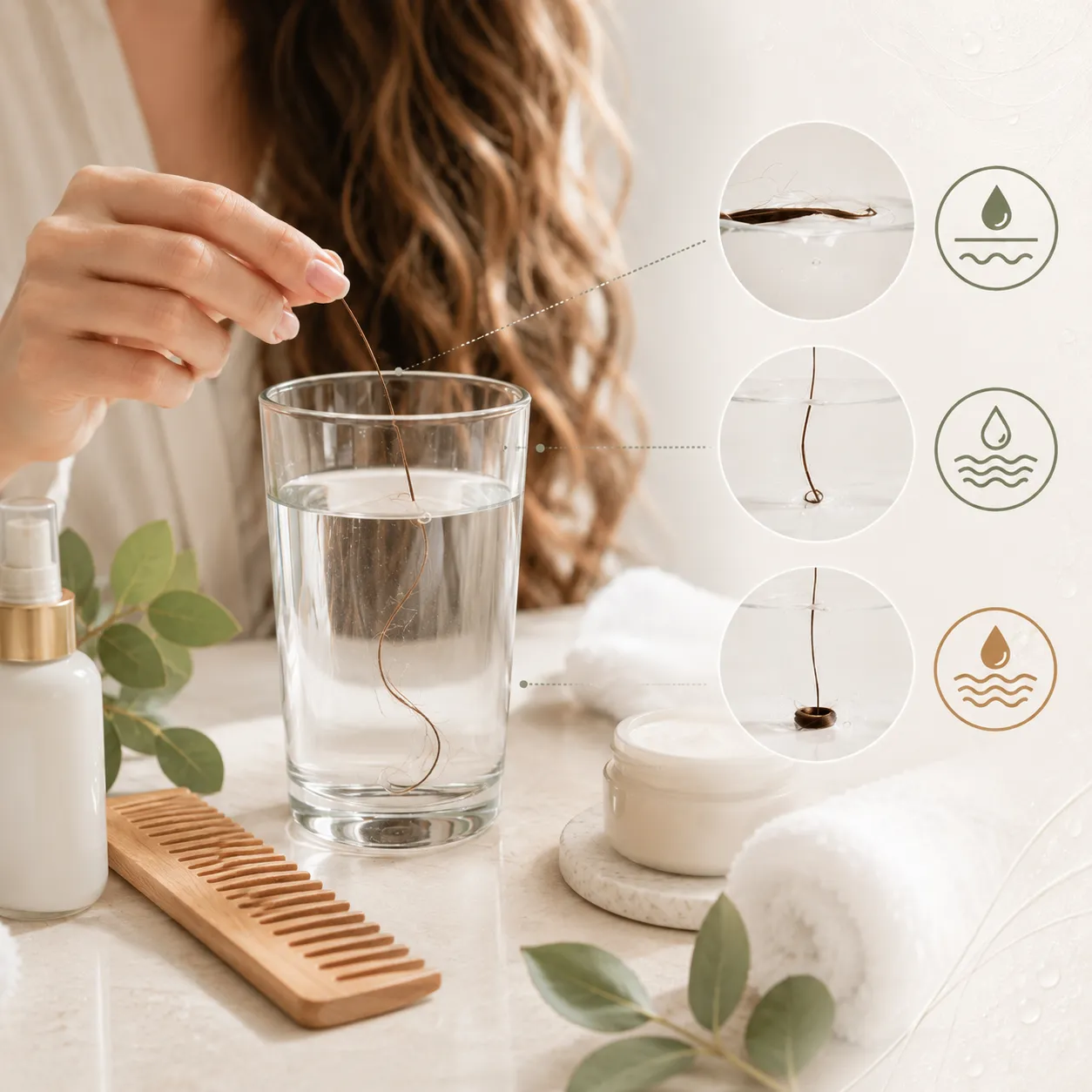
The float test
The float test is popular online, but it should be used only as a rough guide. Place a clean, dry strand of hair into a glass of water and leave it for a few minutes.
- If it floats near the top, it is often described as low porosity.
- If it sits around the middle, it may be medium porosity.
- If it sinks quickly, it may be high porosity.
The drying time test
After washing, notice how long your hair takes to dry naturally. Low porosity hair often takes longer to dry, while high porosity hair may dry quickly but still feel dry or frizzy.
Is the hair porosity float test reliable?
The float test can provide a rough indication, but it is not completely reliable. A strand may float or sink for reasons that are not only related to porosity. Product build-up, strand thickness, and natural oils can all influence the result.
Your everyday experience—how quickly it gets wet and how it responds to conditioner—is often more useful than a single glass-of-water test.
What causes low or high porosity hair?
Some porosity is natural, as genetics influence how your hair behaves. However, habits and environment also play a role. Common influences include heat styling, bleaching, permanent colour, and sun exposure.
If you are concerned about wider changes in hair quality, the hair growth cycle guide explains why visible changes in hair and density often take time to assess.
Best routine for low porosity hair
Low porosity hair usually needs lightweight moisture and careful product choice.
- Use lightweight conditioners.
- Avoid heavy butters if they sit on the hair.
- Apply conditioner to very wet hair.
- Use warm water to help products spread.
- Use a clarifying shampoo occasionally if build-up develops.
Best routine for medium porosity hair
Medium porosity hair usually does well with a balanced routine. Use a gentle shampoo, condition after washing, and protect the hair from regular heat styling. It does not usually need a complicated routine—just stay consistent.
Best routine for high porosity hair
High porosity hair usually needs help retaining moisture and reducing further damage.
- Use moisturising conditioners and leave-in treatments.
- Seal moisture with a suitable oil or cream.
- Reduce high-heat styling and avoid harsh brushing.
- Consider protein-containing products if the hair feels weak.
Hair porosity and curly or textured hair
Hair porosity is especially popular in curly, coily, and textured hair communities because these hair types can be more affected by dryness. However, porosity is not the same as curl type. You can have any curl pattern with low, medium, or high porosity hair.
Hair porosity and product build-up
Product build-up can sometimes make hair behave like low porosity hair. If styling creams sit on the surface, it may be because the cuticle is compact or because residue is already coating the hair.
If build-up is paired with itching, flaking, or scalp discomfort, the issue may be more than product residue. You can read more about this on the dandruff and seborrhoeic dermatitis page.
Can you change hair porosity?
You cannot fully change the natural structure of your hair, but you can influence how your hair behaves. While products can improve feel and manageability, they cannot permanently repair every form of hair shaft damage because hair is not living tissue once it has grown out of the scalp.
Common hair porosity mistakes
One common mistake is treating porosity as a strict label. Your hair may not fit perfectly into one category. Another mistake is buying too many products based on porosity alone while ignoring factors like density, length, and scalp type.
Simple product guide by porosity
Low porosity hair
Choose lightweight conditioners, water-based leave-ins, and lighter oils. Avoid very heavy butters if they leave your hair greasy.
Medium porosity hair
Choose balanced shampoos, conditioners, and masks. Avoid over-processing and unnecessary product layering.
High porosity hair
Choose moisturising conditioners, richer masks, and heat protection. Avoid frequent high heat and rough towel drying.
When hair porosity is not the main issue
Sometimes hair feels dry or difficult to manage because of porosity, but other times the issue is different.
- Scalp flaking may be linked to a scalp condition.
- Sudden shedding may need assessment.
- Breakage may be caused by styling tension.
If your main concern is scalp discomfort or visible changes, start with the scalp conditions page. If you are worried about ongoing shedding, the consultation page explains how professional assessment can help.
Final thoughts
Hair porosity is a useful way to understand how your hair absorbs and retains moisture. The best approach is simple: observe how your hair behaves, test gently, and build a routine around what your hair actually needs rather than following trend labels.
FAQs
What does hair porosity mean?
It means how easily your hair absorbs and holds water, oils, and products, primarily linked to the condition of the hair cuticle.
How do I know if I have low porosity hair?
If water sits on the surface, your hair takes a long time to get wet, and products feel like they are coating the hair rather than absorbing.
How do I know if I have high porosity hair?
If your hair gets wet quickly, dries quickly, frizzes easily, and struggles to stay moisturised even after conditioning.
Is the hair porosity float test accurate?
It provides a rough indication but is not completely reliable due to factors like product build-up and strand thickness.
Can low porosity hair use oils?
Yes, but lighter oils (like jojoba or argan) are often better than heavy butters.
Can high porosity hair be repaired?
Products can improve manageability and smoothness, but damaged hair cannot be permanently restored to its original condition.
Is hair porosity the same as hair type?
No. Hair type refers to texture or curl pattern, while porosity refers to moisture absorption.